China builds Antelope Reef into an island big enough for a runway
Vietnam and a busy shipping corridor would sit within reach of any airfield built on the new ground, and satellite images will show first whether one comes.
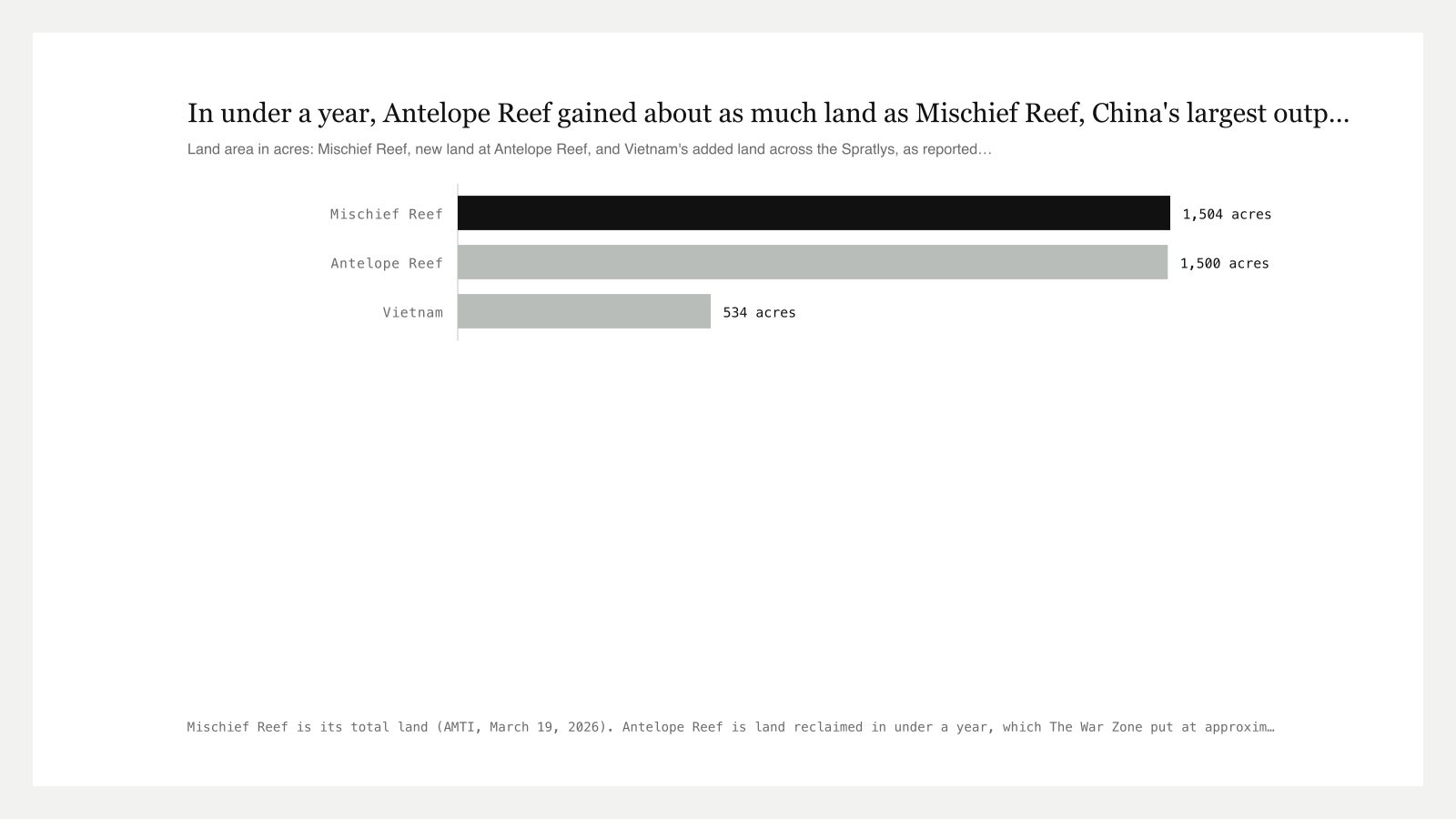
Mischief Reef, the largest Chinese outpost in the South China Sea, measures 1,504 acres of land, and Antelope Reef in the Paracels now differs from it by only a minimal margin, the Asia Maritime Transparency Initiative reported on March 19, 2026.
The War Zone reported on Aug. 21, 2026 that in less than a year China dredged more than a million tons of sand to reclaim approximately 1,500 acres at Antelope. The ground now exists; its purpose does not yet show. What gets built there next will decide whether the western Paracels gain another military airfield of the kind China already runs at its largest outposts, or a civilian settlement on new sand.
Scroll across the figure. Full labels and values are below.
View figure data
| Item | Value |
|---|---|
| Mischief Reef | 1,504 acres |
| Antelope Reef | 1,500 acres |
| Vietnam | 534 acres |
Asia Times reported on April 4, 2026 that the reef sits in the western Paracel Islands, roughly 400 kilometers east of Vietnam and 281 kilometers from China's Hainan-based Sanya naval hub, in a vital trade corridor carrying about one-third of global maritime commerce. A runway there would put aircraft between a Chinese naval hub and a neighbour's coast, beside one of the world's busiest cargo routes.
According to Asia Times on April 4, 2026, the work began in October with dredging at multiple points along the reef's lagoon, and the activity was reported in January 2026 and is visible in European Space Agency Sentinel-2 satellite images. Satellite pictures caught the project early, and the next stage should show up the same way.
The Asia Maritime Transparency Initiative reported on March 19, 2026 that Antelope Reef could now accommodate a 9,000-foot runway of the type China has already constructed at Woody Island, Mischief Reef, Subi Reef and Fiery Cross Reef. The size question at Antelope is settled. The use question is not, although every feature on that list already carries such a runway.
Defense News reported on Jan. 27, 2026 that China has military outposts, including sophisticated military bases such as Woody Island, on 20 islands in the Paracels. Antelope would add to an existing network in the chain rather than open a new front, and it would share that chain with Woody Island, already one of the four sites with a long runway.
According to Radio Free Asia, the four Chinese airstrips at Fiery Cross Reef, Subi Reef, Mischief Reef and Woody Island are likely to be joined by a fifth at Antelope Reef. That is a forecast about what comes next, and it matches the list of runways the reef now has room to copy.
According to China's Foreign Ministry on March 23, 2026, the Paracels are "China's inherent territory," and "necessary construction on our own territory is aimed at improving living and working conditions on the islands and growing the local economy."
The Global Times reported on Aug. 20, 2026 that China ratified the UN Convention on the Law of the Sea in 1996 and, in the paper's account, may build within its own territorial waters without any other country's approval.
The Asia Maritime Transparency Initiative reported on May 8, 2026 that Vietnam has created an additional 534 acres of land across the Spratlys, a separate island chain. China is not the only government moving sand. None of these reports says a runway has been started at Antelope; the military case rests on room and precedent.
Vietnam carries the most direct foreign exposure: its coast lies a few hundred kilometers from a reef that could host military aircraft.
The Asia Maritime Transparency Initiative reported on May 8, 2026 that without the development of Antelope Reef, Vietnam's total reef destruction would have amounted to 89 percent of China's total, but now amounts to only 66 percent. A single Chinese project cut Vietnam's share of that comparison by about a quarter.
Hanoi's building, large as it is, now looks smaller beside China's. Tallies like that one shape how the building race is described, and Antelope has pushed China further ahead in it.
Merchant ships crossing the western Paracels would sail past one more Chinese military airfield if a runway is poured. The corridor carries a large share of the world's seaborne trade, so the effect would reach well beyond the two governments nearest the reef.
Beijing gains the option either way. Ground big enough for a long runway can also carry housing and a harbour, and the choice between them can wait until the moment suits China. Neighbouring navies and air forces must weigh a runway that does not yet exist.
A government that calls the islands beyond dispute has, in effect, taken the building itself off any negotiating table. The treaty argument would cover a runway as easily as a housing block.
The civilian and military accounts do point to different pictures from orbit. Housing, piers and fishing facilities look nothing like a long strip of pavement with hangars beside it, and satellite images will show which appears first.
Antelope Reef has gone from a lagoon to land nearly the size of China's largest outpost in less than a year. Whether a runway follows is now a decision for Beijing, not a problem for its dredgers.