Britain and the EU pursue Russia's A7 network as its token fades
The token's slump does not settle whether sanctions have reached the Kremlin-blessed payment network behind it, and banks linked to that network remain in the firing line.
Russian President Vladimir Putin attended a virtual ribbon-cutting ceremony for the opening of A7's Vladivostok branch in September 2025, according to Foreign Policy. Heads of state rarely turn out for a payment company's new office.
According to Elliptic, daily trading in the network's ruble-backed token has slumped far below its peak. That has not closed the file. According to the UK Government on Aug. 31, 2026, Britain acted on May 26 against key banks, entities and individuals linked to the A7 network. The pursuit now reaches past the coin to the business behind it, and whether sanctions can shut a state-blessed payment system is the open question.
According to the U.S. Department of the Treasury, the company behind the token and its subsidiaries are owned by Ilan Shor, a sanctioned Moldovan oligarch, and by the sanctioned Russian bank Promsvyazbank. A Russian lender, not a crypto start-up, sits at the top of the ownership chain, which makes the network's fate a banking question as much as a crypto one.
A7 claims to have settled more than $86 billion of transactions within its first year of operating, the UK Government reported on Aug. 31, 2026. That is the company's own boast, which Britain repeated without vouching for it.
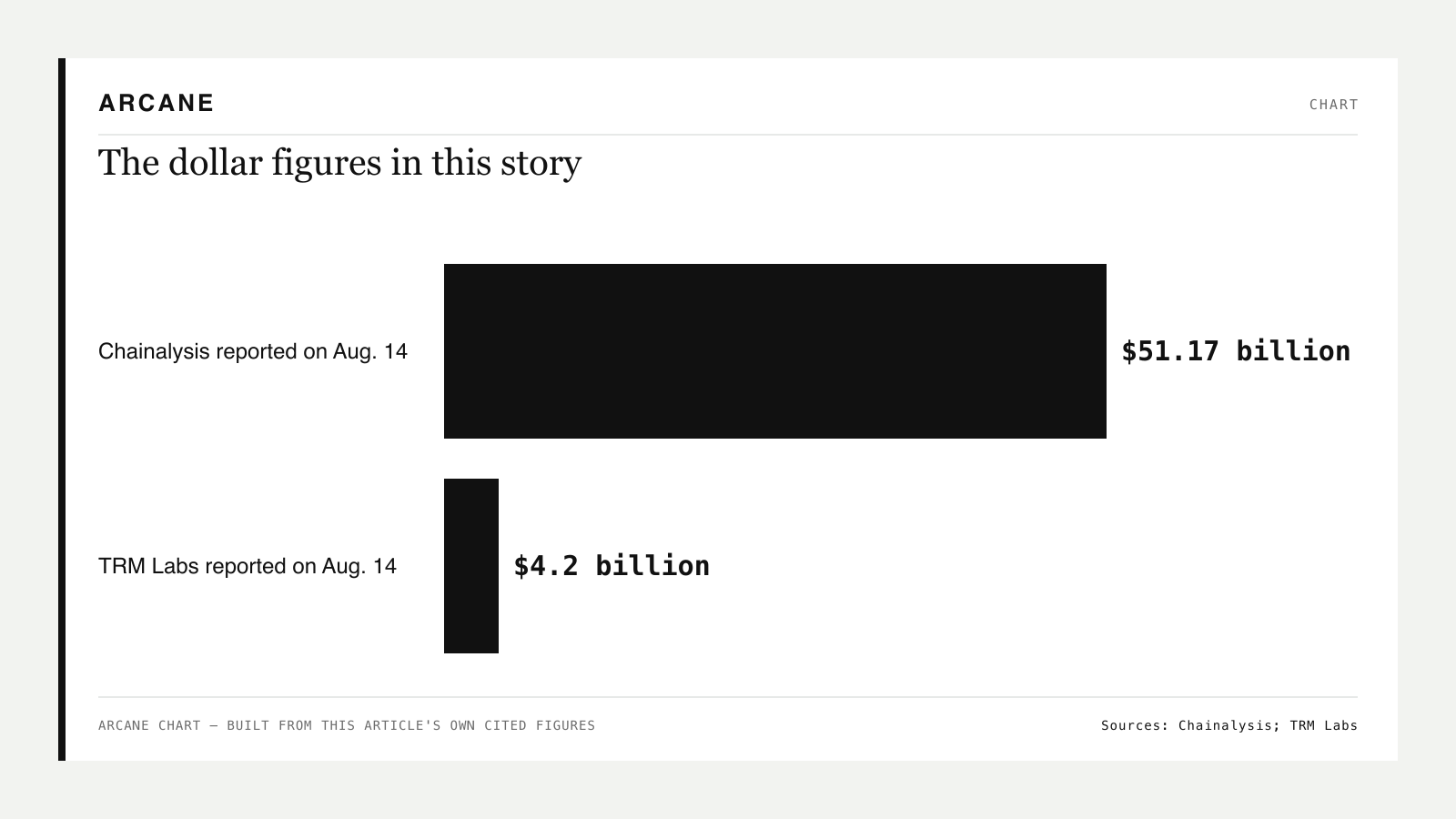
Chainalysis reported on Aug. 14, 2025 that A7A5 had processed over $51.17 billion in volume through the end of July 2025. That is below A7's own settlement claim, but the two numbers cover different periods and count different things, so the gap proves little on its own.
Elliptic reported on Jan. 21, 2026 that A7A5, a ruble-backed stablecoin launched in January 2025, had logged just under 250,000 transactions from 41,300 distinct accounts. A stablecoin is a crypto token built to hold a steady value against an ordinary currency. So few accounts, set against the billions other trackers have counted, looks more like a wholesale channel for businesses than a coin for the public.
According to The Cryptonomist, the network had an "enormous forgery factory" that was industrially producing fake paperwork, particularly invoices, to justify the payments. That suggests the scheme leaned on ordinary banks as well as blockchains, since an invoice is what a bank checks before it releases money for a trade.
According to the U.S. Department of the Treasury, representatives for Shor met with Garantex officers before law enforcement actions led by the U.S. Secret Service, and afterward Garantex officers transferred customer deposits to Grinex. That shows how quickly a shut-down service can reappear under a new name, and why a collapse in one venue says little about the people behind it.
According to Elliptic, average daily transaction volumes in A7A5 fell to a low in June, far below their peak the previous July, and a major security breach hit the Grinex exchange in April. On that record the token faded fast, and a plain reading follows: A7 is already a spent force, and whatever comes next is mopping up.
That reading may be right about the coin. It is weaker on the company. Blockchain trackers see the token, while the forged invoices suggest trade payments running through ordinary banks, where public tracking stops. None of the reporting measures how much the network moved through bank transfers after the token faded, so neither side of this argument can yet be settled from the public record.
The UK Government reported on Aug. 31, 2026 that Britain had imposed sanctions on more than 500 individuals, entities and ships under its Russia sanctions regime so far this year. A7 is one name on a crowded list, which leaves any bank handling Russia-linked payments with a long roster to screen.
The Insider reported on July 24, 2026 that the European Union had added A7A5 project head Leonid Shumakov and Promsvyazbank chairman Mikhail Dorofeev to its sanctions lists, along with the companies A7 Agent and A71. Brussels has gone after the people and subsidiaries, not only the product.
Those listings land first on the executives named and on any lender still clearing their payments.
According to Foreign Policy, the transactions the network processed that were linked to sanctions evasion were roughly equivalent to Russia's prewar annual import bill for high-tech, often dual-use, goods, meaning products with both civilian and military uses. If that channel narrows, Russian buyers of such goods would face slower and costlier payments.
TRM Labs reported on Aug. 14, 2025 that Kyrgyz authorities had issued 126 licenses to virtual asset service providers, firms that trade or hold crypto for clients, by October 2024, and that licensed providers handled $4.2 billion in the first seven months of that year. That measures a whole industry, not the network's share of it. It still shows how large a crypto trade a small Central Asian state had licensed.
A crypto token can lose most of its trade within a year. A payment business built on bank ownership, subsidiaries and invoices is harder to switch off, and the token's fall settles a smaller question than the one its parent company poses.